LED Aluminium Profiles
Shop by profile type
For LED strip
Aluminium channels that house a flat LED strip. Pick by how the profile fixes to the surface, then check the internal channel width against your tape.


Neon flex mounting
Aluminium and PVC tracks that hold neon flex straight, sized to the flex profile rather than to a strip width.

Diffusers, caps and fixings
Flexible covers and correctly sized parts for mounting, sealing and finishing a profile or neon-flex run.


Choose an aluminium LED profile by the width of tape it takes, not by its outside dimensions. Our channels take strip from 10mm to 26mm wide in surface, recessed, corner, bendable plaster-in and in-ground floor forms, in 1-metre, 2-metre and 2.45-metre lengths. Every profile comes with an opal or clear cover and mounting clips.
What size aluminium LED profile do you need?
Measure your tape first, then match it to the internal channel width stated on each product. The external size tells you nothing about fit — a 12mm tape will not enter a 10.2mm channel, and forcing it damages the adhesive backing and the solder joints at the cut points.
- 10mm tape: the 12x10mm surface channel — plinths, cabinet interiors and slim joinery reveals.
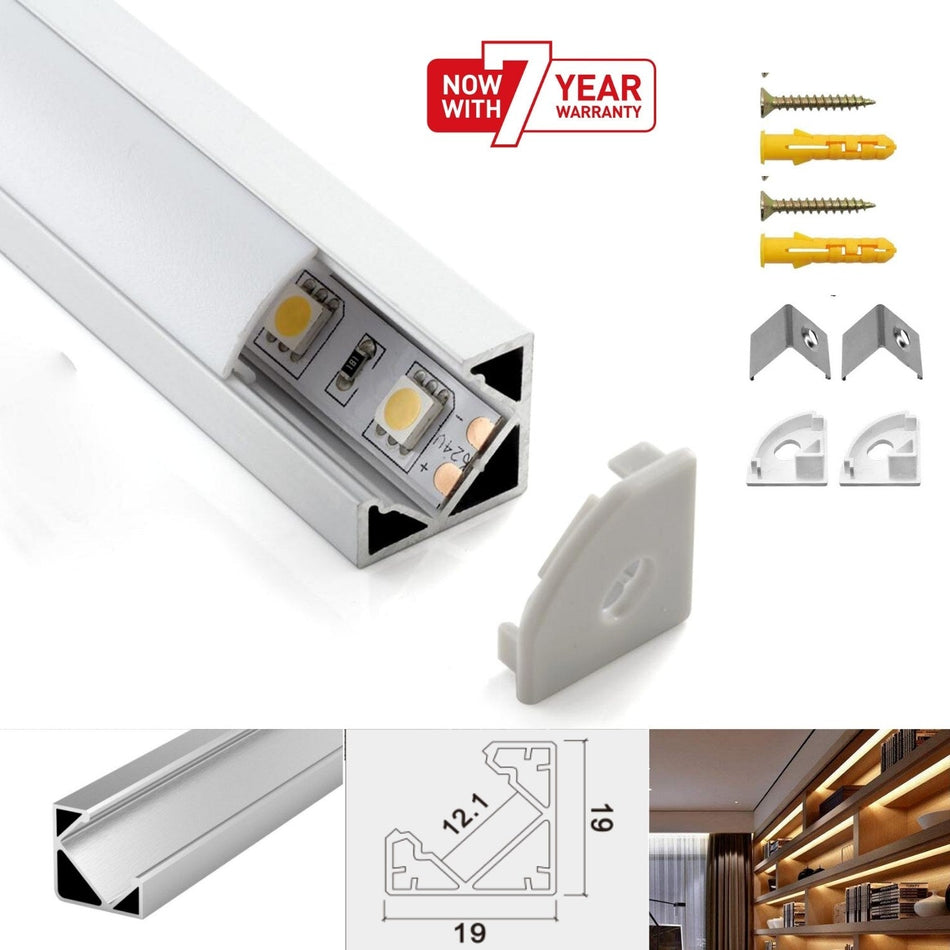
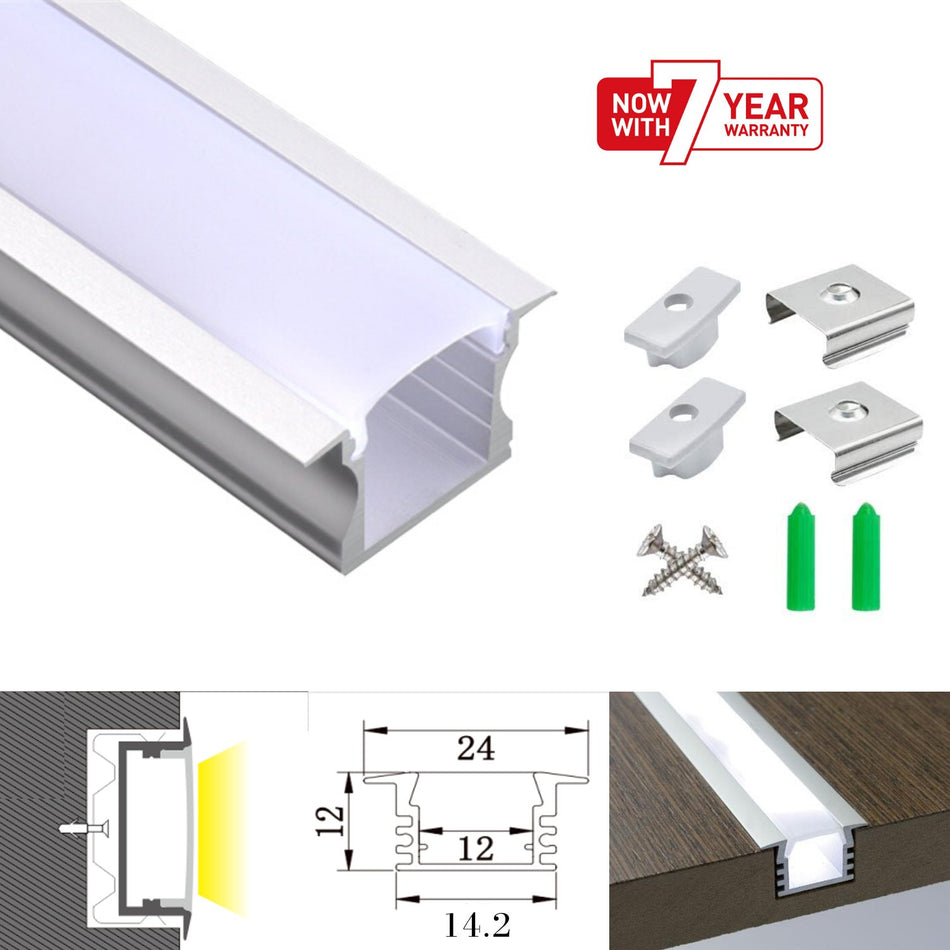
- 12mm tape: the widest group. 17x8mm surface where headroom is tight, 25x7mm recessed for a flush finish, 24x14.2mm recessed where you want depth, and the 16x16mm and 19x19mm corner channels used for coving and cabinet runs.
- 15mm tape: the 60.3x15mm bendable plaster-in profile, for wide COB and double-row strip.
- Up to 26mm: the 30x20mm in-ground floor channel, deep enough to take neon flex whole.
Which aluminium LED profile bends around curves?
The bendable plaster-in profile is the one that curves. It is scored so it flexes in the plane of the wall, letting you follow an arc, a curved bulkhead or a radiused island.
- Order extra tape for curves. Bending shortens the effective run, so an arc consumes more strip than the same distance of straight channel.
- Bend before you plaster. Set the curve, fix the profile, then skim up to its flanges so the finished line is crisp.
- Very tight radius? Use neon flex in a flexible cover body instead of rigid aluminium — an extrusion will kink below its minimum bend radius.
Straight runs on the same job should still use rigid channel. It stays true where a bendable section can waver.
Can you use an aluminium LED profile outdoors?
The channel itself is IP20 and seals nothing — it is an open extrusion with a push-in cover. Outdoor capability comes from the pairing: the profile gives mechanical protection and a clean finish, and an IP67 or IP68 strip or neon flex sealed inside provides the water ingress protection.
- Patios, decking and garden runs: pair with IP67 neon flex or strip, rated for temporary immersion.
- Thresholds and paving that can pond: use IP68, rated for continuous submersion.
- In-ground channels: confirm the substrate and loading with your installer before you set one into a trafficked surface.
IP65 is splash-resistant only. It should never sit in a floor recess or any channel that can hold water.
What lengths do aluminium LED profiles come in?
We stock 1-metre, 2-metre and 2.45-metre lengths. Length is a finish decision as much as a cost one: across a 4-metre run, 2-metre lengths give you one join where 1-metre lengths give three, and every join reads as a faint shadow line in the diffuser once the strip is lit.
- 1 metre: ships on a standard service and suits short cabinet, shelf and stair runs.
- 2 metre and 2.45 metre: fewer joins on long runs. These exceed standard parcel length, so they ship on a long-goods service with its own delivery rate at checkout.
- Cut to measure: tell us your run length and we will cut profile and strip so the joins land where you want them.
Does the diffuser cost you light?
Yes, and it is usually worth it. An opal cover scatters the output so you see an even line instead of individual diodes, at the cost of some measured output. A clear cover keeps more light but shows every LED as a dot.
- Opal: the default for anything at eye level — under cabinets, coving, shelves, stair nosings.
- Clear: for concealed runs where nobody sees the source and you want maximum output.
- COB strip: gives a continuous line even behind a clear cover, because there are no visible dots to hide.
How do you cut and fit an aluminium LED channel?
- Cut the aluminium with a fine-tooth hacksaw or a mitre saw with a non-ferrous blade. Deburr the ends so the cover still slides.
- Cut the strip only on its marked cut points. Cutting between them kills the segment.
- Fix the channel first — screw through the base or use the supplied mounting clips — then lay the strip in and push the cover on last.
- Leave slack at the feed end for the driver cable, and keep the driver accessible. It is the part most likely to need attention later.
- Mitre corners rather than butting them if the run turns; the diffuser line stays continuous.
Not sure which profile suits your run? Send us the length, the strip you are using and where it is going and we will confirm the profile, driver size and cover before you order — get in touch.